Showing posts with label agriculture. Show all posts

Wednesday, 25 September 2019

Is the honey industry killing the bees?

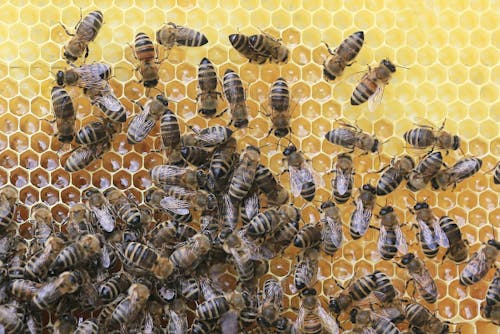
Bees on Honeycomb
Photo from pexels.com
We are all aware of the importance of maintaining a healthy pollinator population. We would lose over a third of our crops without them. Bees and other pollinators do this by transferring pollen between flowers allowing new seeds to be produced and dispersed, increasing crop and wild plant populations. Between 1996 and 2016, the European honey bee population declined by 25% as a result of colony collapse disorder (CCD) which has been attributed to a range of causes, including the removal of wild meadows, pesticides and parasites. Many of us believe that by buying honey we are supporting the growth of this declining population but is this really the case?

The average honey bee colony contains 50,000 bees, with the majority being worker bees whose role is to collect nectar for the hive. One hive can produce 14 KG of honey. That seems like an awful lot for one hive so is it really an issue for us to have some honey? To make 0.45 KG of honey the hive will have to get to two million flowers and travel around 55,000 miles to do this only for us to steal the majority of their food collected which, in my opinion, doesn't seem very fair to the the poor hard working bees. With CCD increasing in concern, we should be giving the bees the best chance for survival and that means ensuring that they have enough food to survive and reproduce.

To increase honey production, some beekeepers, mainly in the US, have resorted to artificial insemination to increase the number of drones in the hive, thus increasing the pollen collected. Although very few beekeepers are doing this is does mean killing at least one drone in order to collect the semen. The head and first segment of the body are crushed in order for the muscles to contract, making it easy to collect the semen. The queen bee is then held down via hooks in order to be inseminated which can lead to injury and possibly death of the queen. There have also been some cases where the queens wings have been clipped to prevent any chance of her flying away. With bee population becoming so scarce, should we be killing bees in order to artificially increase honey production for human consumption?

Despite these issues there are many other reasons for a declining bee population that don't involve honey. There is an argument that bee farms increase populations by increasing the amount of hives, planting flowers and reducing pesticides to increase bee populations. Bees in honey hives will also pollinate the surrounding area, helping to increase plant biodiversity which is the base of every food web, in turn supporting larger mammals in the area. It has also never been proven that there is a link between honey production and declining bee populations and there are many things we can do to limit the impact honey production has on bees. One thing could be to ban artificial insemination and limit the amount that can be taken form a single hive. So this begs the question, should governments be doing more to reduce our impact rather than stop eating honey altogether?

Personally, I think that ethically it isn't right for us to take the honey from the bees especially seeing as the entire hive is built around it. There are so many other alternatives, such as maple syrup, agave and date syrup, all derived from plants essentially cutting out the middle man. With bees being so important and becoming so scarce, shouldn't we be doing everything in our power to protect them?


Resources -
https://phys.org/news/2016-01-complex-worldwide-bee-declines.html
http://www.bbc.co.uk/guides/zg4dwmn
https://friendsoftheearth.uk/bees/honey-ethical-guide
https://www.peta.org/issues/animals-used-for-food/animals-used-food-factsheets/honey-factory-farmed-bees/

Sunday, 19 May 2019

Rewilding: The most basic but effective conservation technique?

It's exciting to see a book about wildlife conservation in the UK being a top seller and highly advertised in bookstores. If you haven't heard of the book 'Wilding' yet by Isabella Tree I would highly recommend you pick it up. The book talks about the conservation technique of rewilding (obviously) in the Knepp estate in West Sussex and how this technique can be replicated in other habitats. The book defines this technique as essentially doing nothing. It is removing all intensive management and allowing natural succession of a habitat to occur with minimal human impact or intervention. The idea is that it will increase the population of the native species and possibly attract new species. This can also include the reintroduction of native species that are no longer found in that habitat (similar to my blogpost on beaver reintroduction). However, this is sparking some debate, particularly with locals when this technique is done on open land (or commons) such as Dartmoor which begs the question is a technique that we should be implementing more?

One key idea in this concept is to promote naturalistic grazing patterns to maintain sustainable vegetation levels and provide different exposure levels for a range of species. For example, in her book Tree links the population of Dartmoor ponies to an increase in the rare butterfly species the Marsh Fritillary; an insect that declined in population 66% between 1990 and 2000. She also rights about a study claiming the grazing of ponies has helped to increase the weight in grazing cows as the remove the tough upper layer of grass that bovines cannot digest. Whilst I don't recommend anyone eats meat, there is the argument that farmers can still raise livestock on the moor and can advertise the meat as organic and free range. This is what is done on the Knepp estate and has lead to an increase in profits for the landowners.

Another idea is to remove any intensive management techniques already in place such as drainage channels used in agriculture. The blocking of the channels (also known as grip blocking) will help to restore the water table leading to the reformation of rivers, streams and wetlands. This is what happened on the Knepp estate which has helped to increases the diversity of habitats, and subsequently increased overall species diversity. If this occurred nationwide it could help to increase the UK's ranking on the Biodiversity Intactness Index which is currently 189/218. In areas of Dartmoor this had lead to an increase in Sphagnum, moorgrass, braken and gorse which are the key plants that support endangered habitats such a blanket bogs. If this could be used to increase the size of our peatlands, this could significantly increase the rate of carbon sequestration as peat is a greater store of carbon than terrestrial plants.

The Knepp estate has also seen an increase in eco-tourism as they promote a guided nature walk and a sustainable camping site. Whilst the book does not mention a specific figure in profits, this could help bring tourists to areas, such as national parks, provided that they stick to paths and follow the guides to avoid damaging the plant life. This could create a new economy for locals, reducing our dependence on intensive agriculture which is always a benefit in terms of ethics and climate change.

However there are objections, mainly from farmers. The idea of reducing intensive farming will most likely result in reduced yield as fertiliser and pesticide isn't allowed under this scheme. Reintroduction programmes are also expensive with the beavers in Knapdale costing the Scottish government £2 million which, given the countries current financial state, could be invested in the public sector. Personally, I feel that ethically we should be looking to invest in our conservation and this method can be done on a budget and we need to take any measure we can to improve the state of our wildlife. So to sum up, I think rewilding could be easily implemented by landowners and help improve the UK's biodiversity.


Click here to buy Wilding on Amazon. 


Wednesday, 20 March 2019

The Importance of Peatlands

University of Leeds | News > Environment > Peatland Code ...
Photo of a peatland habitat. from leeds.ac.uk

In the UK, 10% of our land area are covered in peatlands and are vital not only to our economy and wildlife but as a form of carbon sequestration. Despite these factors, peatlands are given little care, unless designated by governments, as they are often just seen as bogs with nutrient rich soil making them ideal spots for the growing agricultural industry. However, the elevated water table means that drainage is required which removes the required vegetation (also know as bog builders)  that have lead to a dramatic decline in global peatland habitats. So what is being done to reverse this and why are these habitats so important?

So peatlands are essentially a soft, nutrient rich soil that forms over a long period of time, in a similar way to coal, under anaerobic conditions. These habitats also acts as a large store of water that leads to the colonisation of Sphagnum mosses that lead to the development of peat habitats such as swamps and wetlands. In the UK there are 10 key peatland Sphagnum species with most common being Baltic Bog-moss that is protected under UK legislation. These mosses have a sponge like structure meaning they store large quantities of water, preventing the surrounding area from drying up. This specific property also helps to prevent any decay and decomposition aiding the accumulation of peat and helping to maintain these diverse habitats. The bog building plants also help to shape the habitat by creating pool and hammock structures that increase the water table, making more water more available to plants on the surface. If these species are removed, it would cause a decline in peat formation, water supply and affect the topography of the habitat.

Global, peatlands are currently storing 500 GT (which is more than all forests) of carbon as a result of peat being made of dead and decaying vegetation which is stored instead of being released into the atmosphere in the form of carbon dioxide. When peatlands are drained and deforested, that stored carbon is then released into the atmosphere so imagine the damage that would be done if all the peatlands around the world were gone? RIP polar bears. These habitats also act as a store of water which not only benefits biodiversity but can also increase ground water levels in the surrounding area and the moss structure helps to filter the groundwater. This means that our water reservoirs would face serious decline in these peatland habitats continue to decrease in size and quality.

Peatlands tend to have a low species diversity due to the habitat creating a small niche so only specialised organism can live there. As the habitat is currently declining many of the species are subsequently following, including the Common Scoter and the Mountain Hare, and the specialised habitat requirements of these species mean they cannot colonise other habitats. As these habitats are declining the competition between and amongst species is increasing therefore reducing the population However, action is being taken especially regarding the protection of breeding birds as several peat habitats, including the North Pennies, have been designated a SPA (Special Protection Area). These areas are maintained and managed in order to increase specific bird populations. Most of these habitats are also listed a SSSI's (sites of special scientific interest) which are areas managed by Natural England due to their biological or geological interest. This ensures that land owners take all the necessary precautions to protect these areas, including many peatland habitats, from damage.

Despite vast restoration efforts, I feel that the importance of these areas is not emphasised to the general public, mainly because they aren't necessarily as aesthetically pleasing as the bright and vibrant tropical rainforests we see. Do I think more could be done? Absolutely. However, the UK government is making good efforts to designated and protect these areas but could invest in future expansion projects to increase the size of our peatlands.


Resources

Sunday, 4 November 2018

Animal Agriculture and Climate Change

Agriculture | Climate Vulture
https://climatevulture.com/category/blog-topics/agriculture/

Climate change is a major global issue with it being a key talking point amongst governments and IGO's (*ahem America*). Everyone is aware of the obvious contributors including exhaust emissions and fossil fuels but recently it has been suggested that animal agriculture may be a bigger contributor to the greenhouse effect than originally thought. There has been evidence to suggest that as our meat consumption has grown so have our carbon emissions but this could also be due to the growth of industry, population and a greater dependence on fossil fuels. So does this mean documentaries like Cowspiracy are wrong?


It is suggested that livestock is responsible for 18% of greenhouse gas emissions globally. With the addition of the byproducts, it could be as high as 51% with a projected increase of 80% by 2050. These byproducts include transportation, food and heating. Most of these emissions are methane that are produced by the growing cattle industry and bad land management and with methane having a global warming potential 86 times greater than carbon dioxide, it is no wonder livestock are essentially destroying out planet. Methane is produces in the stomach of cows and sheep as the ingested plants undergo fermentation that produces methane as a by-product essentially meaning cow farts are destroying the environment. It doesn't take a genius to realise that as the "need" for beef grows so will these toxic methane emissions. In fact methane emissions from livestock are similar to those produced by natural gas, questioning if we should be shifting from promoting electric cars to a more plant based diet.

With animal agriculture covering an estimated 45% of land, livestock is a primary contributor to habitat loss and deforestation on a global scale. Globally, all agriculture is responsible for 80% of deforestation, with the biggest causes for habitat destruction in the Amazon basin being cattle ranches and soya plantations. Although crops are a cause for deforestation, we will see a very small percentage of these yields as most will be used for animal feed. In order to achieve maximum yield and profit, cattle require a large amount of food. If we think about this in terms of tropic levels, as we move up a level (or a stage in the food chain) 90% of energy is lost so we need more cows to produce the amount of beef we need to meet our energy needs. This means more cattle ranches and more animal feed. As most of us are aware, forests are an important carbon sink and help to reduce the enhanced greenhouse effect and if agriculture continues to grow, so will the amount of greenhouse gases in the atmosphere.

Did you know a farm with 2,500 cattle produces the same amount of waste as over 410,000 people? If it is disposed of incorrectly it can result in anaerobic digestion, again resulting in the release of methane. Another side effect is eutrophication reducing nutrient availability, creating algal blooms and a decline in biodiversity. Not to mention the fact it is a direct cause of water pollution and poses a huge health risk to animals and humans alike.

So overall do I believe a plant based diet will help reduce carbon emissions. Yes, all the facts support this. However it is important that we also understand that we have a meat eating culture spanning thousands of years and we have been taught our whole lives nutrition must contain animal products. Therefore this change cannot be expected to happen overnight but even if you only eat meant 3 or 4 times a week, you will still have significantly cut your carbon footprint.


Resources -